
- komal sharma
- 28 Jun 2026
AI Jobs vs Traditional Jobs in 2026 – A Viral Deep Guide to the Future of Work
Introduction: The Day Work Started Changing Forever
Imagine a normal office morning in India, 2026.
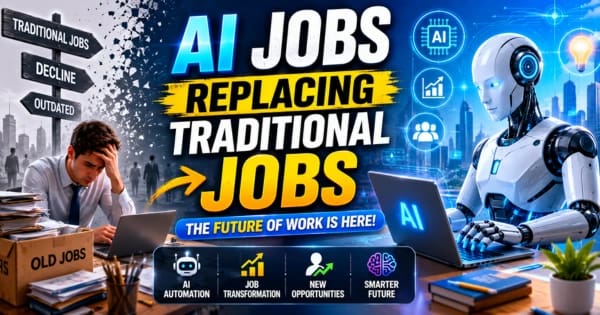
An employee sits at his desk, opens his laptop, and realises that half of his work has already been completed by an AI system. This simple scenario perfectly explains how AI jobs vs traditional jobs in 2026 are reshaping the modern workplace.
Reports are ready. Emails are drafted. Data analysis is done.
The AI has already completed most of the routine work. Now, the employee’s role is to review the output, apply human judgement, and make the final decision.
This is not science fiction. This is the new workplace reality of 2026, where the shift from traditional jobs to AI-powered roles is redefining industries across the world. The growing impact of AI jobs vs traditional jobs in 2026 is changing how people work, learn, and build their careers.
Artificial Intelligence is no longer just a tool—it has become a silent controller of the global job market
But here is the biggest misconception:
The reality?
AI is not eliminating jobs…
It is redefining them
And those who fail to understand this shift will feel the impact first. As AI jobs vs traditional jobs in 2026 continue to reshape the workforce, adapting to AI and learning new skills will become essential for long-term career success.
A Simple Truth: How AI Is Changing the Job Market
Think of a company that once had 10 employees.
In 2026, the same company:
- 5 humans + AI tools = same output
- or 3 humans + AI automation = even higher productivity
Jobs are not disappearing…
Human roles are being shrunk, upgraded, and reshaped
What Is AI Job Automation?
AI job automation means the following:
Using machines and algorithms to perform repetitive, predictable tasks that were previously done by humans. This process is at the heart of AI jobs vs traditional jobs in 2026, where automation is transforming how businesses operate and how people work.
Real 2026 Examples:
- Customer support → AI chatbots and voice bots
- Hiring process → AI resume screening
- Accounting → AI bookkeeping systems
- Marketing → AI ad generation and targeting
- Warehouses → robotic systems
Simple rule:
Where there is repetition, automation enters. This is the core principle behind AI jobs vs traditional jobs in 2026, as repetitive and predictable tasks are increasingly being handled by AI-powered systems.
Why AI Is Replacing Jobs So Fast (Reality Check)
Speed Humans Cannot Match
AI completes in seconds what takes humans hours.
2. Cost Efficiency
Companies reduce salary, training, and operational costs.
3. Near-Perfect Accuracy
AI performs structured tasks with fewer errors.
4. No Fatigue
AI works 24/7 without breaks or burnout.
5. Massive Scalability
One AI system can handle thousands of operations simultaneously.

2026 Real-World Transformation: Industries That Changed
Banking Sector
Before: Manual verification, long queues
Now: Instant AI loan approval, fraud detection systems
E-commerce
Before: Human recommendations and inventory tracking
Now: AI predicts what users will buy before they even search
Manufacturing
Before: Human assembly lines
Now: Smart robotic factories running 24/7
Customer Support
Before: Call center agents
Now: AI voice bots handling millions of calls
Bottom line:
Industries are not dying—they are being rebuilt. The transformation of AI jobs vs traditional jobs in 2026 is driving businesses to adopt smarter technologies, creating new roles, improving productivity, and reshaping the future of work.
Story Mode: Jobs Most at Risk
Imagine an entry-level worker doing simple data entry every day. As AI jobs vs traditional jobs in 2026 continue to reshape the workforce, repetitive tasks like these are becoming increasingly automated.
In 2026, his entire work:
is done by AI—10x faster and cheaper.
High-Risk Jobs:
- Data entry operators
- Telecallers / cold callers
- Cashiers
- Basic accountants
- Warehouse pickers
- Entry-level writers
- Administrative assistants
Painful truth:
Repetition = replacement risk.
But Another Truth Exists: AI Cannot Replace Everything

AI is powerful, but some areas remain uniquely human.
1. Creativity
AI can generate content but cannot create true human emotion.
2. Decision Making
AI provides data, but humans take final business risks.
3. Human Connection
Doctors, teachers, psychologists—emotion still matters.
4. Deep Innovation
Science and research are driven by human curiosity.
Big Surprise of 2026: AI Is Creating New Jobs
For every job AI removes, it creates new opportunities.
High-Income Emerging Careers:
- AI Engineer
- Machine Learning Specialist
- Prompt Engineer
- Data Scientist
- Automation Consultant
- AI Trainer
- Robotics Engineer
Reality:
The AI era is not a crisis—it is an opportunity explosion. As AI jobs vs traditional jobs in 2026 continue to reshape industries, those who embrace AI, develop new skills, and adapt to change will unlock greater career opportunities than ever before.
Future of Work (2026–2035): A New World Order
1. Human + AI Teams
Every job will include AI assistance.
2. Remote Global Economy
Working for international clients becomes normal.
3. Skill-Based Economy
Degrees lose value; skills dominate.
4. Freelance Revolution
Flexible, project-based income becomes mainstream.
5. AI Everywhere
Every profession integrates AI tools.
Future-Proof Skills (Most Important Section)
Digital Survival Skills
- AI tools usage
- Automation platforms
- Basic technical knowledge
Thinking Skills
- Problem-solving
- Critical thinking
- Decision-making
Creative Skills
- Content creation
- Branding
- Communication
Money Skills
- Data understanding
- Business logic
- Marketing basics
Survival Guide: How to Stay Safe and Successful
Step 1: Treat AI as a Tool, Not an Enemy
Don’t fight AI—use it.
Step 2: Upgrade Your Skills
Old skills are declining. New skills = rising income.
Step 3: Build Multiple Income Streams
Relying on a single job is risky.
Step 4: Build Digital Presence
Start freelancing, YouTube, or blogging.
Step 5: Learn Daily
In the AI era, static knowledge leads to failure.
Economic Shift: The Big Picture

Negative Side:
- Low-skill jobs are shrinking
- Entry-level opportunities are decreasing
Positive Side:
- High-skill salaries are increasing
- New industries are emerging
- Productivity is exploding
Final shift:
The shift from an effort-driven economy to a skill-powered economy is one of the biggest outcomes of AI jobs vs traditional jobs in 2026, where knowledge, adaptability, and AI skills are becoming more valuable than routine manual work.
Final Battle: AI vs Humans (Reality Check)
AI Strengths:
- Speed
- Accuracy
- Automation
- Scalability
Human Strengths:
- Creativity
- Emotion
- Leadership
- Ethics
- Strategy
Final Truth (Most Important Line):
AI will not replace humans. The real shift in AI jobs vs traditional jobs in 2026 is that people who learn to work alongside AI will have a significant advantage.
But humans who don’t use AI, adapt to new technologies, or upgrade their skills may find themselves left behind in the evolving job market.
Conclusion: The Real Message of the Future
After 2026, the job market is moving in a clear direction. The shift in AI jobs vs traditional jobs in 2026 is reshaping careers across every industry.
• Low-skill jobs are fading
• High-skill jobs are growing rapidly
• AI-powered careers are becoming the new standard
Final Thought:
AI is not a threat—it is a career accelerator. The shift in AI jobs vs traditional jobs in 2026 is creating new opportunities for those who are willing to adapt, learn, and grow.
Those who embrace AI will:
• Grow their income
• Access global opportunities
• Secure their future in an AI-driven job market
